
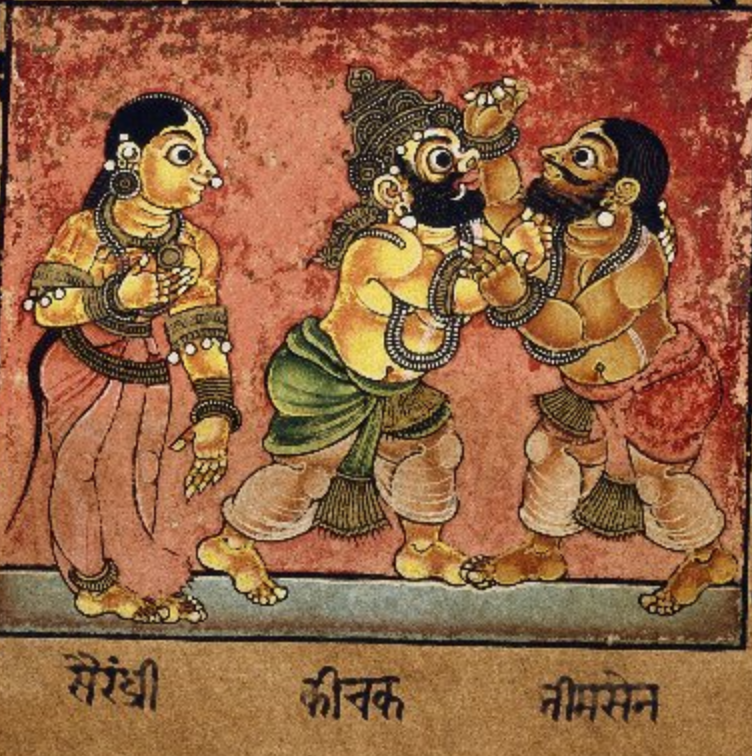
This course explores the twin themes of war and love through some of the most influential works of Indian tradition and world civilization in their cultural context: the great epics Rāmāyaṇa and Mahābhārata, the philosophical Bhagavadgītā, Kālidāsa’s romantic drama Shakuntalā, the animal fables of Pancatantra, and the adventures of Cilappatikāram (Tale of an Anklet). The works covered in the course were originally composed in Sanskrit or Tamil, but we will read them in English translation and watch clips from films and tv series based on them. No exams, but a group creative mid-term and an individual final project.
- Teacher: Heidi Pauwels

This course explores the twin themes of war and love through some of the most influential works of Indian tradition and world civilization in their cultural context: the great epics Rāmāyaṇa and Mahābhārata, the philosophical Bhagavadgītā, Kālidāsa’s romantic drama Shakuntalā, the animal fables of Pancatantra, and the adventures of Cilappatikāram (Tale of an Anklet). The works covered in the course were originally composed in Sanskrit or Tamil, but we will read them in English translation and watch clips from films and tv series based on them. No exams, but a group creative mid-term and an individual final project.

This class provides a survey of the World Religion Hinduism from its earliest evidence to modern times. It introduces the major gods and their stories, the most influential scriptures and their ideals, as well as festivals, modes of worship and major institutions.
Developments will be studied more or less chronologically, emphasizing those aspects that are directly relevant to current attitudes and practices.
Requirements:
Short class presentation on living Hinduism
Project: outline to be presented in workshop in the final week and final paper in lieu of exam

This class provides a survey of the World Religion Hinduism from its earliest evidence to modern times. It introduces the major gods and their stories, the most influential scriptures and their ideals, as well as festivals, modes of worship and major institutions.
Developments will be studied more or less chronologically, emphasizing those aspects that are directly relevant to current attitudes and practices.
Requirements:
Short class presentation on living Hinduism
Project: outline to be presented in workshop in the final week and final paper in lieu of exam

HINDI 501 Winter 2026: READINGS IN CLASSICAL HINDI (Braj)
Instructor: Heidi Pauwels, Gowen Hall 233, tel. 3-4235 hpauwels@uw.edu
Prerequisites: Students should have a solid knowledge of modern standard Hindi
Aims:
The primary goal of this class is to provide an introduction to the language and literature of Braj Bhāṣā, the literary form of Classical Hindi associated with the Braj area in Western UP. This will be accomplished by a short grammar introduction and close reading of selections from representative literary works in the original language. To ease in we will start with prose sections (amusing stories and stories of saints), moving on to the devotional (bhakti) songs of Mīrābāī, Sūrdās, and Raskhān, and the dazzling court (rīti) poetry of Bihārī. We will listen to diverse renderings of the songs, and study modern popular perception in for instance Bollywood films.
Course requirements and grading:
Class participation/preparation: 40% Portfolio due F W10
Class Presentation: 30 % As assigned, preparation in portfolio
Final Presentation and Paper 40 % Presentation W10, paper M exam week


